
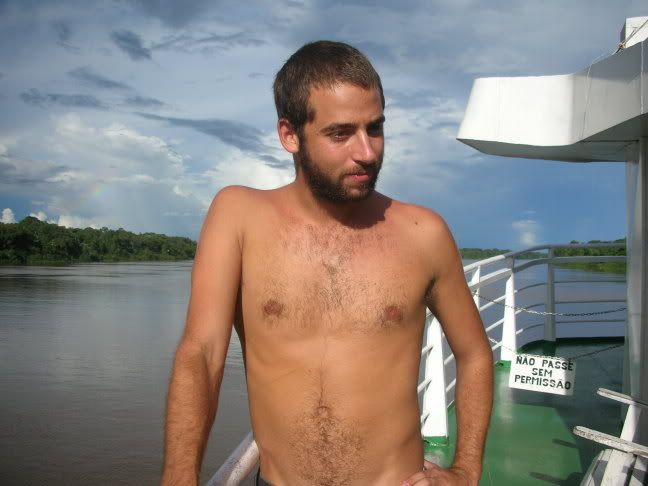
Travel with Daniel

Wednesday, May 24, 2006

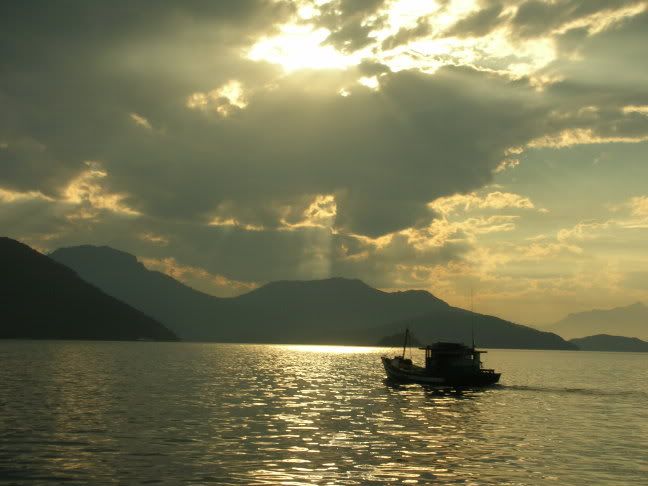
El Barco


Ageing and used, safe enough. Peeling paint and rusty steel. Waxy ropes and very loud.

El Barco had three levels, perhaps 30m long, open sides.

The bottom levels mainly contained cargo, the crew´s quarters and the kitchen.

The middle level had the mess area, toilets/showers and most of the passengers.

The top level had a small bar, some tiny air conditioned cabins and the remaining passengers.

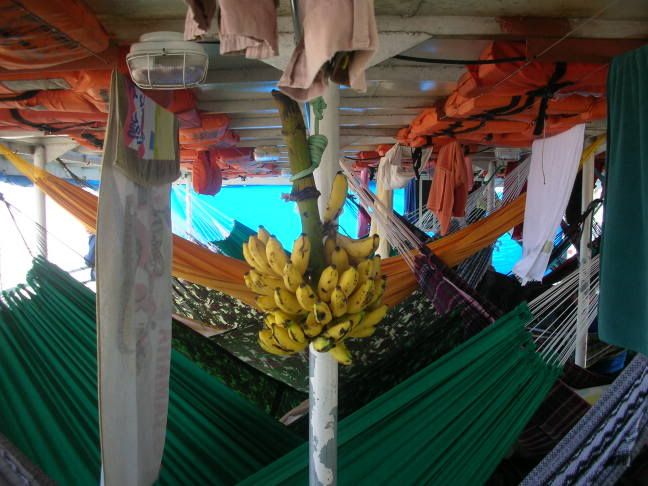
All of the passengers, bar a few inside tiny and expensive (relatively) cabins slept in hammocks swinging from every available hook.

Of course, after la selva I had become accustomed to sleeping in a hammock. This is not to say that it was in any way comfortable. I did however become comfortable with the product of a night in a hammock; a sore neck.

My hammock swung on the top level, I purchased my ticket prior to boarding and the vendor had obviously assumed that I wanted ¨first class¨, being a gringo and all. Later I discovered that my ticket had cost only marginally more than an ¨economy class¨one. The only advantage of being on the third ¨first class¨ level was its lack of toilets. In the night, when the head overflows, or people miss, urine splashes about on the rustry steel floor below the hammocks. On the top level, there was only one toilet, broken anyway.

I had been warned that the quality of food on these boats is very poor. Wrong. Basic food, but sufficient. Still, I was glad that before boarding Carlos and I went to the market at the waterfront in Manaus and bought some extra supplies. I bought a big branch of bananas, yellow at the top green at the bottom, 5 litres of water, one kilo of oranges and some bread and cheese.


I had planned to talk to you about all of the horror stories plastered over the net, circulating amongst backpackers and in travel guides regarding the boats on the Amazon. Stories about food, delays, insects, theft, rape, and unfriendly Brazilians (impossible!)

Instead, lets talk reality.

Our cargo consisted of Brasil nuts, sugar, a palette of microwaves and two jet skis. I spent a lot of my time sitting on the bow (bottom level, always empty) shelling and eating stolen buts. Learnt to break the nuts open pretty cleanly by the end.

Also on the bottom level was a small palette of cargo belonged to someone moving house. They were not aboard. TV, DVD, sofa, chairs, coffee table, dining table, bed, cupboard, fridge and other stuff. On day two I went downstairs to do some nut cracking. As I walked past a small space in between the sugar and the jet skis I saw a blue flicker.

Some passengers from the middle deck had carefully opened the palette which was wrapped in clear plastic. The had set-up the TV and DVD player in front of the sofa and coffee table, just like home. They sat and drank beer, watching the only DVD they had, a collection of Guns n Roses video clips. They assured me they would put it all back neatly as if nothing had happened. The captain and crew were of course fine with this. I heart Brasil.


I made some lovely gringo friends on the boat:

Justine Belgium)
Anneke (Belgium)
Christine (Germany)
Andreas (Germany)
Lars (Denmark)
Thomas (Austria)
Jorge (Portugal)
Shane (New Zealand)
Sarah (New Zealand)
Giovanna (England)

Hope you are all well.

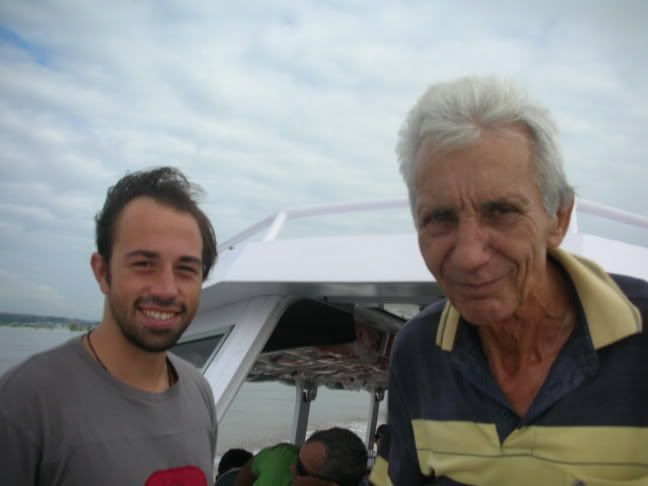
It was great to be able to share travel stories with fellow travellers. So far I had not done much of that. However, I spent most of my time speaking with the Brasilians aboard. I took advantage of the situation, all of us stuck on a boat. They poor people had nowhere to hide! Actually, as per the Brazilian spirit everyone was always more than happy to talk, slowly and patiently. Sometimes we passed a Portuguese-English dictionary around like a conch.


I sat on the bow at dusk, watching the colors change and the river snake. I thought I would read a lot whilst on the boat, instead I was captivated by the changing light. I was hypnotised by the purple brown river. Did not read much at all over the 5 days (four and two halves, really.) I am not very good at describing landscapes, so instead, I will share an extract from the one book I did manage to finish whilst aboard.

"Going up that river was like travelling back to the earliest beginnings of the world, when vegetation rioted on the earth and the big trees were kings. An empty stream, a great silence, an impenetrable forest. The air was warm, think heavy, sluggish,. There was no joy in the brilliance of the sunshine. The long stretches of the waterway ran on, deserted , into the gloom of overshadowed distances."

Joseph Conrad, Heart of Darkness, p30.

Francis Ford Coppola adapted Conrad´s story to Apocalypse now.

I adapted Conrad´s story to my river trip.

Later that night the storms started.

They continued over the next two. We swung wet all night, belted by winds and cold rain. When morning broke we thawed out over overly sweet coffee and a plain stale white roll.

On day three something special started to happen. At first I was confused. Why is the Shaman (there was a Shaman on the el barco) throwing garbage bags overboard?

Then, I saw it. Children in dugout canoes were frantically paddling toward our boat, yelling and doing a little dance. In the Brazilian spirit of giving and sharing, the Shaman was throwing bags of clothes, toys and books to the kids.

It was not only the Shaman. He was just first. The whole boat it seemed was prepared for tis. Many of the passengers had plastic bags with gifts/donations for the riverside children. I was done with my mosquito net, and I had a map of the world in my backpack. I quickly put them in a plastic bag and tied it firmly before throwing it overboard. A canoe with mother and child plucked it for the river and continued to search for more.
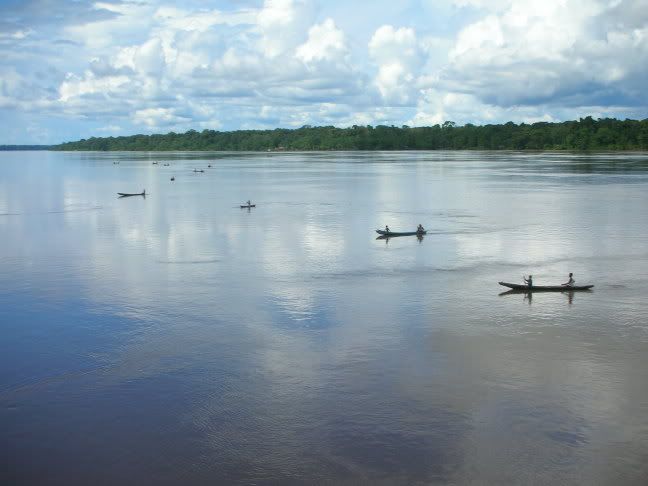


These children live in riverside communities - usually mixed indigenous and non indigenous families. They no longer live deep in La Selva, rather on the edge of the rivers. Of course, here there are no roads. Living on a riverbank is the Amazonian equivalent of living on a road. I spent two half-days with one of these families before and after La Selva. Their lives are affected by western culture and industry, yet they remain pure and simple. Fishing, farming and reproducing.

The gift giving continued for the whole day. Armies of canoes approached our boat as we passed each village. The river narrowed in parts, got wide and narrowed again. I saw more and more examples of the industrialisation of the river. From what I saw, the region is purely a resource bank. The river serves as transportation. I saw the largest ships I have ever seen. I saw oil tankers and cargo ships, but also once-were-trees dugout canoes.

By day five my bananas had ripened progressively as the fellow passengers helped themselves. I had timed their ripening perfectly. My bread was stale, oranges gone. Small achievements such as these must be mentioned.

We arrived at the coastal city of in
Belem after 5 days (four and two halves, really) travelling at 22 knots per hour with the downstream flow of the river.

No terrible food, no delays, no insects, no theft, no rape, and no unfriendly Brazilians.

The boat experience was not the National Geographic picture that we have in our heads. In fact, nor was La Selva. Closer, but not. The river experience, was very special nonetheless. It was honest and pure. At times a little testing, but always special.


Now, only two weeks left to experience the oh so special North East. The true heart of Brasil.

Tuesday, May 16, 2006

La Selva


Now I am in Madrid, Spain.

I am one or two stories behind, details as to why will be revealed soon enough.

For now, lets talk lions and tigers and bears.

I made sure to get a flight during the day from Brasilia to Manuas, a large city in the Amazon. Of course, I also made sure to get a window seat.

Among the many sights tourists are expected to see in an Amazon visit is the "Meeting of the waters". Two rivers, the Rio Negro (black coffee in color) and the Rio Solimões (coffee with milk in color) meet at a fork. I knew that when I got to Manaus I would make every effort to avoid a package tour of the essential sites such as these. For this reason I got a day flight and sat at the window. From the air I got an uninterrupted view of this spectacular phenomenon. Like shy children at a school dance the waters refuse to mingle. Later I got to see it up close from a boat anyway. We can move on now.

What else did I get to see from the air? A massive amount of water, particularly for an Australian. There are more rivers here than anywhere else in the world. It is big and it is wet. Now wet season, the river/s are up to 20m higher than in the dry. The dense jungle (La Selva, from now on) was for the most part, flooded. When I saw the first river upon approach, I was stunned at how wide it was. Then, I saw another. Another. Another even bigger. Then I saw Manaus.

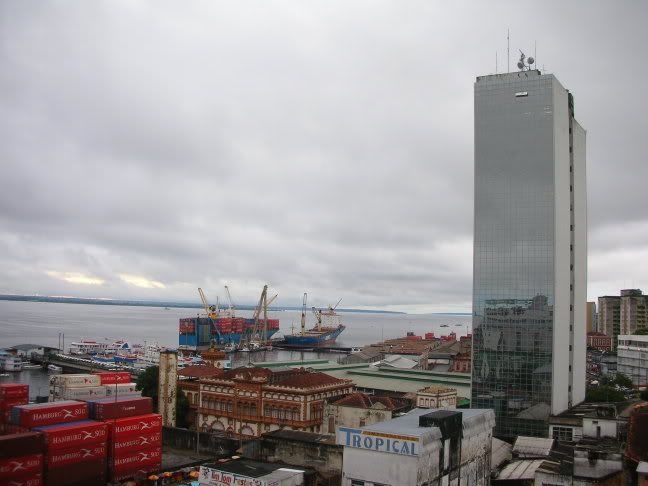
Out of the green and the black, an ageing soggy metropolis.

Manaus suffers. Manaus suffers from hatred. Travellers hate Manaus. Enviromental orgasisations hate Manaus. When you go, you too might hate Manaus.

For many it is simply a gateway to the Amazon for an expensive day in La Selva. Even with low expectations, upon arrival I hated Manaus. Correction: disliked.

Later, after much thought, my perspective shifted and I became sympathetic to those who live in the city. I accepted that the city itself is not the problem, only a product of a larger problem. Certainly Brail has in many ways benefited from the development affored to it by the natural resourses in the Amazon, however it is also clear that much irreversible damage has been done t the region. Regarding Manaus, the question here is:

What makes a city good? Or perhaps What makes a city bad? I tend to believe that a city is – the sum of its inhabitants. Once I overcame the remarkable smells, the towers of shipping containers lining the river, the filty port and the mouldy walls, Manaus relevaled itself as a friendly city born out of necessity. Manaus suffers from the same disease as any other city built on industry. Don't hate the player, hate the game.

So, if I didn't do a "Jungle tour" or a "Meeting of the rivers tour", what did I do?"


Also, why am I using so many rhetorical questions in this entry?

Actually, to the first I will give an answer, so technically it is not rhetorical. Is that right? Fuck. There it is again.

Let's just move on.

I was walking the street of Manaus looking for someone that would take me into la selva without staying in a "Jungle Hotel". I wanted an experience without a brochure.

I found Carlos from Portugal. Old polo shirt, leathery skin and grey hair. Always a cigarette. Slimy and experienced. A wink every sentence.

Already in his office (we found out later that infact he has no office, he had just borroweed one for ethe afternoon) was another Carlos. Carlos II, a fellow backpacker is also Portuguese.


From the start I had a confident mistrust towards Carlos. At the same time however I was fascimnated by his confidence that we would have a special esperience in la selva with him. He had lived in la selva in Venezueal for 21 years with an indigineous woman has had come to Brasil four years ago. Both Carlos II and I decided that, despite our doubts we would trust Carlos. We would leave in the morning with him and some things.

Whilst walking the the street with Carlos II a Brasillian man called out, in Portuguese, "Don´t trust that man, he has an illegal visa!" A little unsettling, and exciting.

On the run from the authorities with a slimy Portuguese man in the amazon!

For the three day stay IN la selva, Carlos, Carlos II and I had:

Machete
Canoe
Hammock (each)
Lighter
Pot
Pan
Plate (each)
Fork (each)
Mosquito net
Shotgun
Some food
Cachaça
Fishing line
Forked spear
Water
Some personal belongings
An Amazonian kid, Joga.

After a day of travel by road, boat, road, boat, canoe we arrived found a bank or Lago Mamori that was not flooded with water. It was however, flooded with mosquitos.


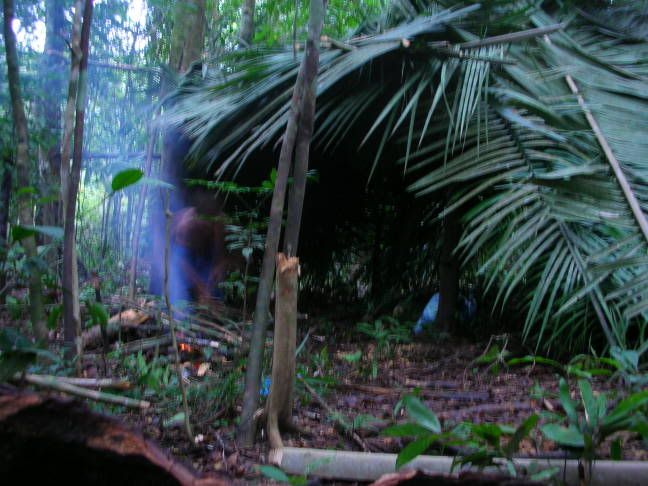
It was quite late in the afternoon, and because of the canopy it was almost dark. We hurried to build a shelter out of young trees and palm frongs. With the help of Joga we built a shelter wih two sides and a waterproof roof in about two hours. We used nothing but found materials. Vine for rope. Overlapped plam frongs for the roof. Our hammocks hung firmly from the structure. It was amazing.


We had caught some piranhas earlier in the day, so we made a fire a cooked them. We had two each, with some rice. They are a very tasty fish. By six or seven at night we were all truly rooted. It was at about that time that I realized even with clothes and repellent the mosquitos were also having their dinner.

They mosquitos were getting pretty bad, so we cut our only small water bottle into two cups and made
capirinhas and retired to our the safety of out hammocks and mosquito nets.


Not so.

The mosquitos, particularly the large silent black ones that carry malaria, can penetrate the hammock. The attack from below, drawing blood from any surface that you lye on. There is a choice; let them attack one area relentlessly or allow them to spread their feast over various parts by continuously shifting your position in the hammock.

This, combined with the buzzing of the smaller mosquitos makes for a memorable night. Remember, it is only 7pm.

Before nightfall, Carlos II was a little worried about the lions and tigers and bears. To be more accurate, he was worried about the crocodiles, jaguars and snakes.

By the time ten o´clock came around Carlos II has worked himself up into quite a sweat. Of course, this is not difficult when the temperature does not drop below 28 ° (humidity 80%) at night in the canopy. But, my point is, he got really scared. Every bump, gust, rustle or drop would stir Carlos II into a frenzy of pacing and questioning.

Start Transcript.

Carlos II :What was that?


Two laps of fire.


Carlos: Nothing


Carlos II :Did you hear that?

Carlos: Yes, falling fruit.


Two laps of fire.


Me: Are you going to pace around all night Carlos?

Carlos II: DO YOU HAVE A PROBLEM WITH THAT?

Me: Yes.

Minutes pass

Carlos II :Shit ! I am pretty sure that was a Jaguar!

Three laps of fire, one lap of Carlos and the shotgun

Me: Relax mate, go to bed.

Carlos and I: Shutup!

Carlos II: But I swear I heard something growl!

Carlos: It was me. Sleep now!

Carlos II: How can I sleep when the jungle is out to get me? Huh ? What have you done Carlos?You are crazy, trying to kill us man!

Two laps of fire.

Carlos: I will soon enough!

Minutes pass

Carlos II: I need to wee.

Me: So, wee.

Carlos II: Where?

Me: I don't care where.

Carlos II: I am scared

Two laps of fire.

Me: Have you never pissed in the bush before mate?

Carlos II: Not with snakes around.

Me: Just take it out and piss. Right there is fine with me. Fine with you Carlos, Joga?

Joga: snore

Carlos: Yes, fine with me. Piss now.

Carlos II: Okay, but I need you to come with me.

Me: Very funny.

Carlos II: No, I am serious!

Two laps of fire.

Me: You want me to be your piss partner? Okay but I am holding the torch and nothing more.

End Transcript.

So, Carlos II and I stood back to back whilst he pissed on a tree. He was squeezing hard to get maximum flow you know, get the job done fast. For this I was grateful.

Whilst standing back to back with Carlos II, I noticed something.


The dry leaves on the ground at my feet, were glowing silver. Carlos was not able to properly explain why, but the dry leaves were glowing a silvery white in the moonlight. I knelt down (Carlos II had finished pissing) and played with the leaves in between my fingers for minutes. This moment, as I crushed the leaves into a glowing powder, was the tipping point. It what my point of realization- I was in the Amazon. Carlos sneakily let us make small discoveries like this one independently; enriching our experience.

I spent the rest of the night listening to the sublime symphony of insect, but I could not wait to get up in the morning. I was first out of my hammock (although none of us bar Joga really slept) and attended the fire to make breakfast.

The following two days were spent observing la selva. I spent a lot of my time wandering around watching the microcosms of plants and trees, insects and birds, water and earth.

We spent time in the canoe gliding through the flooded sleva picking fruit off trees to eat and catching fish to eat. La selva put me at peace. Even with (serious estimation) 200 mosquito bites I was at peace. The first night was difficult, the second was worse. However, I was much more comfortable. I could have lay there and listened the sublime symphony endlessly. I followed patterns, listened for questions and answers, heard the harmony as a whole and picked out each individual click from the canopy.


The rest of the night I listening to the sublime symphony of insect, but I could not wait to get up in the morning. I was first out of my hammock (although none of us really slept) and attended the fire to make breakfast.

The following two days were spent observing la selva. I spent a lot of my time wandering around watching the microcosms of plants and trees, insects and birds, water and earth.

We spent time in the canoe gliding through the flooded sleva picking fruit off trees to eat and catching fish to eat. La selva put me at peace. Even with (serious estimation) 200 mosquito bites I was at peace. The first night was difficult, the second was worse. However, I was much more comfortable. I could have lay there and listened the sublime symphony endlessly. I followed patterns, listened for questions and answers, heard the harmony as a whole and picked out each individual click from the canopy.


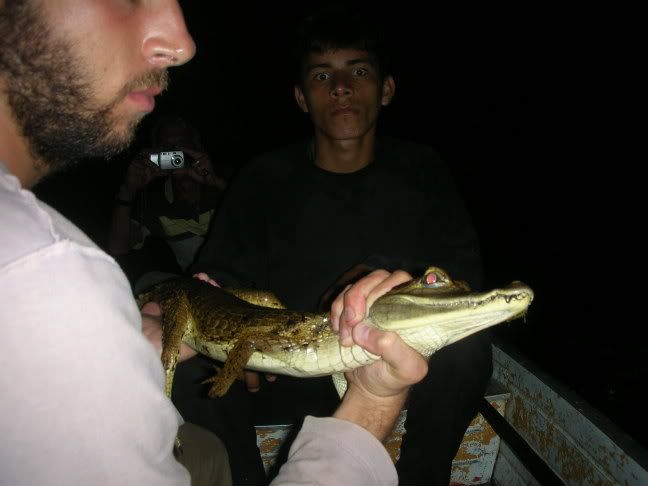
Also, we speared a couple of crocodiles from our canoe in the night. We ate the second one with salt and lemon.

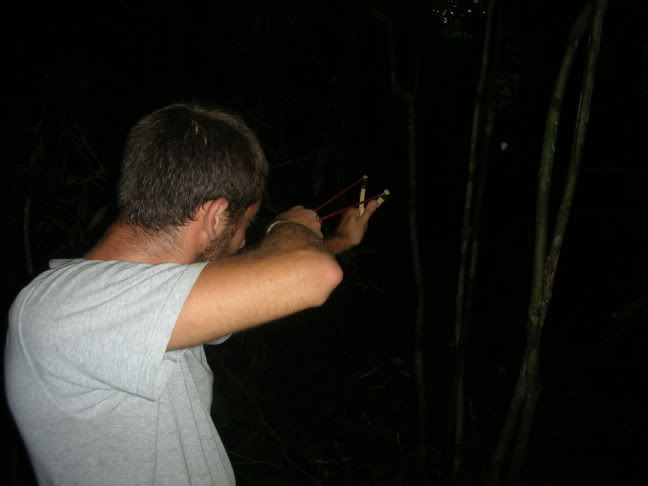
What else? I swam amongst piranhas, learnt to climb a tree like a monkey, learnt that you have to hold live crocodiles really firmly to stop them snapping, learnt to properly use a slingshot, and learnt to let go. I let go of my mistrust for Carlos, and was rewarded.

We arrived back in Manaus and thanked Carlos for what he had showed us, and for what he had not.

The flowing morning I boarded the Nelio Correos, a boat that I would spend the next five days aboard.


Friday, May 05, 2006

Capitalism


Post dolphins, I had one day in Rio before heading inland.

It gave me a chance to say goodbye to my friends.

I said goodbye to Renato my beer guy.

I said goodbye to Maria my stew lady

I said goodbye to Priscilla my laundry lady.

I even said goodbye to a Police-man that I had spoken to the week prior. Police in Brasil wear a patch on their uniform next to their name, displaying their blood type. I had a little exchange with him where I said “Hey, I am O+ also man!” We high fived and I made tracks to Brasilia, on my way I visited Ouro Preto.

Ouro ptero (Black gold) is considered, at least by those wishing to categorise it, “the Cusco of Brazil" I should have remembered that apart from the pleasant manicured colonial charm, an of course the surrounding sites, I did not LOVE Cusco.

Ouro Preto, in the state of Minas Gerais was a mining town. To some degree, it continues to be a mining town. Now however, instead of gold, minerals and gems, locals mine for tourist dollars.

I have no interesting stories. Oh, maybe one. I was there for the final day of Semana Santa, Easter week. On this final day I followed around a parade of many, singing and banging pots of their heads. When the procession reached a plaza at the bottom of towm, an interesting re-enactment took place.

Judas, traitor of Jesus (right?) had been constructed out of papier maché. Exuberant children high on free lollies had strung him up by the neck and were singing and dancing. A public lynching always puts a smile on a child's face, in my experience. I was baffled. Really. I am no expert on Catholicism, but from what I remember forgiveness and thou shalt not kill appear once or twice in official documentation.

I arived in and Brasilia quickly realised why many advise against a visit. The guidebooks tell you not to bother. Travellers tell you not to bother. Brazilians, generally, tell you not to bother.

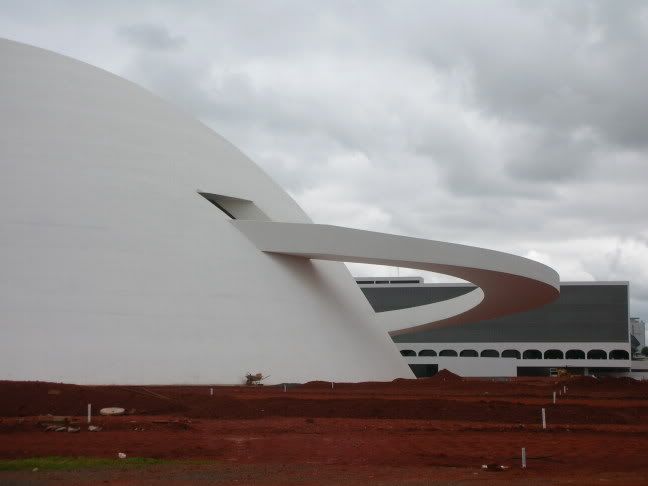
I first noticed the clay. Bright red clay has polluted Oscar Niemeyer and Juscelino Kubitschek’s Utopian vision of the perfect capital. Soil creeps up the sides of the white concrete buildings. Organic brasil, with its rich fertile earth tries to overpower this remarkably inorganic city.

Then, I noticed how regardless of the perfect plan, the city fails to function properly. The city is divided into zones; such as commercial, hospital, military, government, residential. This layout makes life difficult for Brazilians unaccustomed to such an oddly structured design. The Brazilian way of life certainly does not fit in Brasilia. Still, most Brazilians are very proud of their spectacular capital.

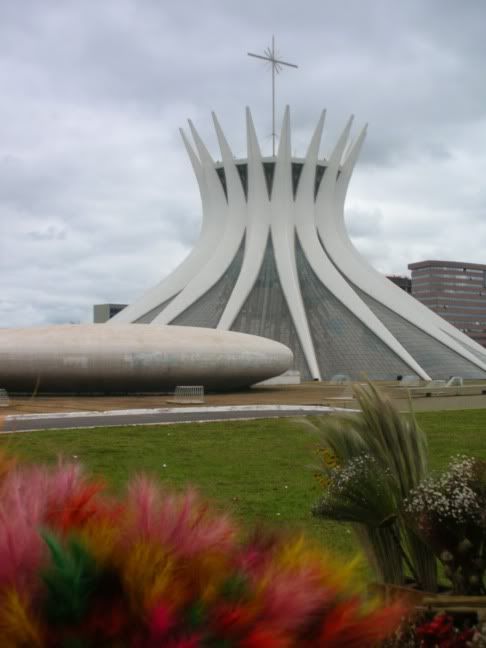
I spent almost three full days admiring this architectural playground. Built in four years (completed 1961) it remains a hot flat plain where stunning shapes dominate. Beautiful modernist architecture, creepy and abstract, demands your attention.


I tried to visit the Congress, but the day I was there President Lula was in conference with the foreign ministry, They would not let me in the building. Maybe I should have shaved and sported a black suit.

My final day was on April 21st, Tiradentes Day. Brazilian indepence day. Just like Indiana Jones and the Temple of Doom, on this day the sun rises in between two towers at the south end of the city. I woke early to witness this phenomenon, but it was a cloudy anti-climax. Oh well. Cool idea .

I had a great time in Brasilia, I found the inhabitants (mostly government workers) very friendly, helpful and accommodating. I left with my curiosities satisfied, confirming of an important travel lesson - go, decide for yourself.

Next up: Amazonia.


Monday, May 01, 2006

Respite


I guess I kinda wrecked the surprise, having already talked about Eliot.

Eliot Goldstone, whom I traveled with in Nicaragua, was in Brazil. When I arrived in Rio he was traveling with a mate, Jeremy Dukes, in the beautiful North East, enjoying the beaches and the b**ches.

My arrival cut their fun short, I think. They flew down south to Rio and we spent a couple of days piss-farting about.

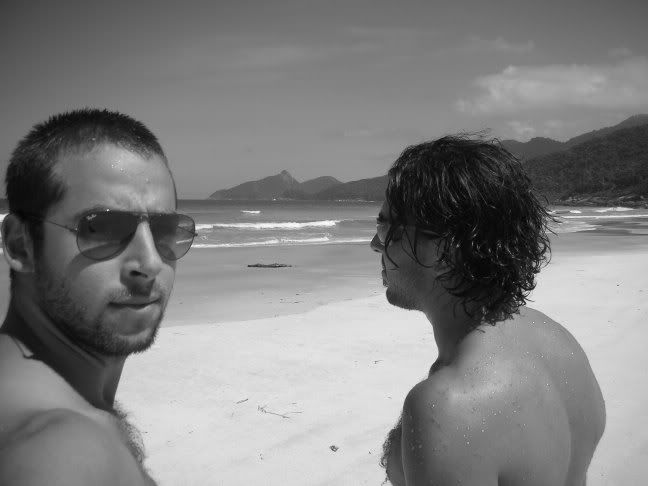
Jeremy flew to Miami and Eliot and I traveled to Ilha Grande, a big island a few hours south of Rio. I had been in cities for a while, Mexico City then Santiago then Rio. I needed a respite from towers fumes and traffic lights. I needed boats and beaches, trees and a tan.

We had planed on staying on the island for a few days. Loosely.

We hiked to beaches. We took boats to beaches. We went to bed early and repeated. We got chased into shore by a small shark. We read, swam and chatted about the kind of stuff that you chat about whilst on a beach. Eliot had been doing this in the North East of Brazil for the last few weeks, but It did not take much arm twisting to persuade him to stay for “one more night.” I just sang a little Phil Collins Was it Genesis? I dunno. Not worth the Google. Our few days turned to eight.

We went snorkeling on an organized tour. It was lovely being on a boat all day and swimming, but the snorkeling itself was beyond crap. However, we did get a chance to do some impromptu freedive practice which would come in handy.

The following day we wandered around town, looking for an alternative to the overcrowded tourist. We went into a few SCUBA shops. We had no intention of paying to SCUBA dive when there is not really much to see under there. We wanted to hitch a ride on one of the dive boats out to the south side of the island where the water is clear and less frequented. The second dive shop we asked offered us a day on their boat, with four SCUBA divers, for less than a sixth of the price of SCUBA.

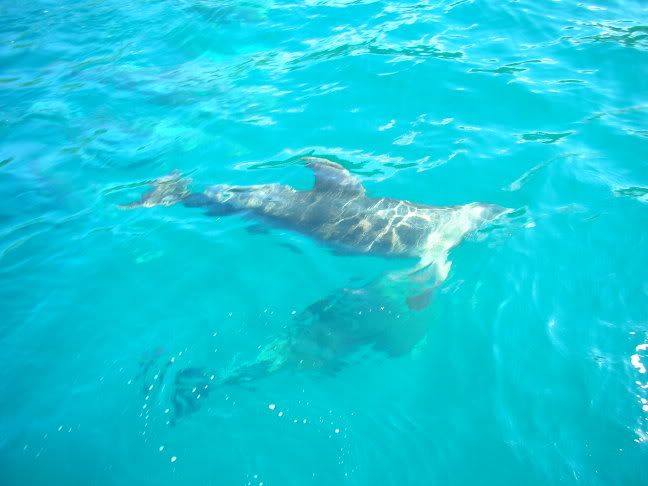
Eliot and along with four single syllable Americans, Brad, Frank, Doug and Rob (I had to grit my teeth to control my laughs), took a small wooden dive boat out to a small island off the South coast of Ilha Grande. After a few freedives looking at rays, urchins, eels, sea snakes and introduced coral from Australia we saw a pod of 12 dolphins or more.


After some observation we noticed that they were doing loops in the bay rounding up sardines for lunch. They drew circles around the silver school, working together to ensure a full feed.

I was careful not to be too splashy, in the main I swam underwater - dolphin kick with fins. Somehow I felt that maybe his would be a better way to get close to them. I arrived to find I was in the middle of their loops, in the eye of the storm. As the encircled me I dove to about 8 or 10 meters to view them at depth. As I was about to ascend a young dolphin appeared out of the dark below, white belly gleaming.

She (A girl dolphin, I can only assume.) was swimming almost straight up toward the surface a few meters in front of me. This mammal with lungs and a heart and of comparable size to us somehow, sometimes, display subtle nuances of expression.

There was a pause in her movement as tail missed a kick. I cannot be sure, maybe my brain was playing tricks due to O2 deprivation, but I saw it. Just as she paused, she looked at me and tilted her hear a little to the left. The dolphin from the depths saw me. She saw me see her. We made eye contact for a brief moment that, as the cliché goes, felt like minutes.

We swam with the pod for hours, getting back in the boat for a rest every now and then. Eliot and I were lucky to be able to view the dolphins from a depth, armed with some basic freedive skills. With only a mask a fins we had freedom of movement. Even Brad, Frank, Doug and Rob removed their bulky tanks and BCDs to join us.

What did this day make me feel?

It made me feel connected. I felt connected to the sea. I felt connected to life. This was the respite from cities I had sought. The circles they drew in the water left me spinning for days, even now I dream about this happening again.

Since then I have bored dozens with the above story. I tell the story with grand hand gestures and wide eyes, like a child. Of course, as you read, the count increases.

As always, I value my time spent with Eliot. Spending time with him gave me a chance hook my experiences – talk with a friend who is a fellow lone traveler is special. We seem to meet in salty environments. We must enjoy the ocean as much as each other. We must share the same love of the shimmer of the sunset on the blue at the end of the day. We must share the same love of a salty back at the end of the day. Again, as the cliché goes, “At the end of the day” it is the ocean that makes us happy.

I was going to tell you about some bad stuff that happened on our way back to Rio – like our bus hitting a pedestrian. Now is not the time. Now is happy time.

From here, I am off to the interior. The mining district, the Capital, the Amazon. Until then, play nice.

Note to self: Buy underwater camera.